Summer Before First Year
- Attempt Foundational Knowledge waiver exams for each of the four subject areas.
- Attend MODs, a 3-week summer orientation in the Urban environment of New Haven and forested landscape of Connecticut.
This program provides students with an in-depth understanding of natural and social systems that can be applied to environmental and natural resource problem solving in a policy or management context.
The Master of Environmental Management curriculum draws from coursework in the natural and social sciences and focuses on the complex relationships among science, management, and policy. The purpose of the program is to provide students with an in-depth understanding of natural and social systems that can be applied to environmental and natural resource problem solving in a policy or management context. In addition to course work, students are expected to hone their capacities as leaders and managers through summer internships, professional skills courses, and other opportunities.
The MEM curriculum requires students to focus on an area of specialization, while still offering the flexibility to tailor their course programming in a way that exposes them to other disciplines and subject areas. This structure assures that students develop both depth and breadth in their course of study. Students can choose from more than 100 courses offered by YSE faculty and have access to an even larger number of courses from across Yale University.
All MEM students are required to choose one specialization.
Specialization are designed to ensure that students obtain sufficient depth in their chosen area of study. Specialization requirements account for 18 of the 48 total credits required for the MEM degree, and it is possible to add a second specialization. Students have until the end of their second semester of study to choose their specialization, which will be listed on their transcript, upon completion.
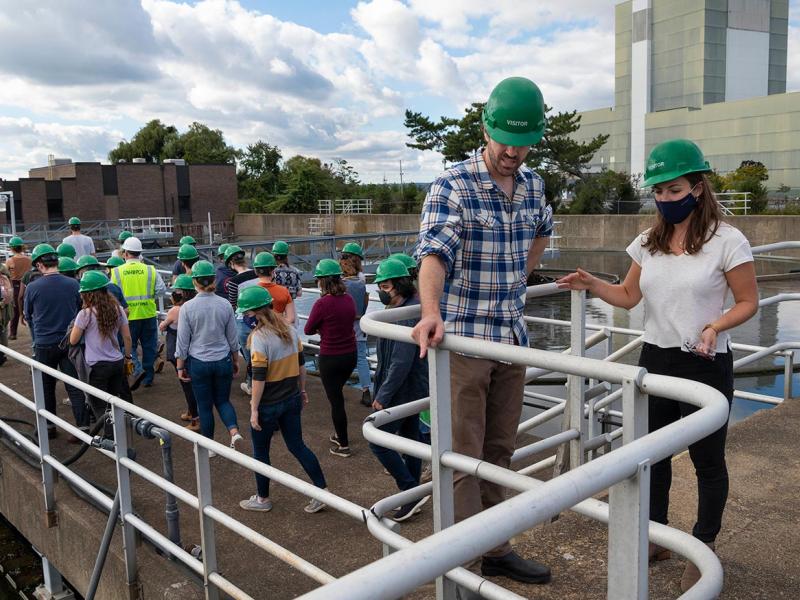
At YSE, education and training extend well beyond the classroom. Participate in our unique summer orientation program, MODs; travel widely for field research and internships; attend global conferences and climate talks such as the U.N. Climate Change Conference (COP 26).
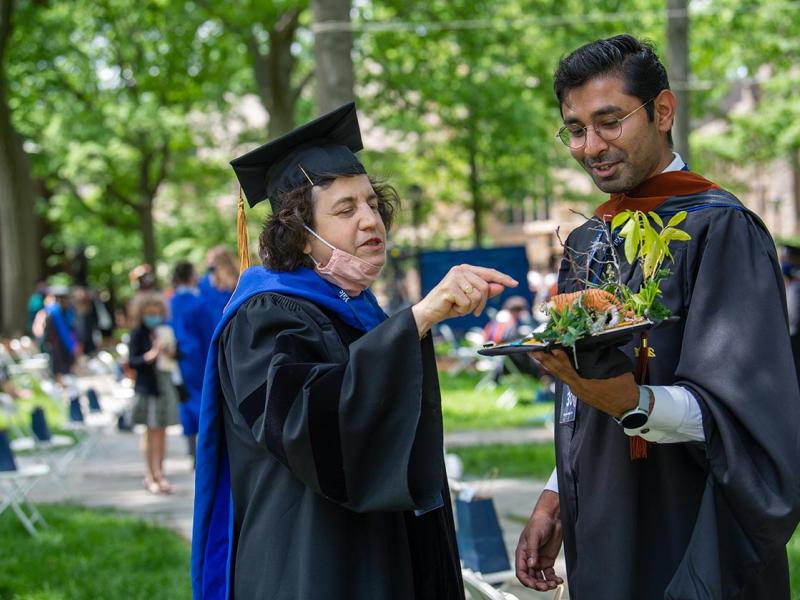
Working closely with some of the top experts in their fields is one of the advantages of a YSE graduate degree. Our faculty are committed to mentoring the next generation of environmental leaders to tackle the world’s most urgent problems.

Jinali Mody ’23 MEM is reducing the environmental impacts from fashion with a new vegan alternative leather made from banana crop waste that the company says uses 90% less water in production than animal leather products and results in 90% less carbon emissions. “Solving the climate crisis requires concerted efforts across all industries and not just energy, transportation, and carbon capture. Building a sustainable fashion industry is the need of the hour,” says Mody.
In 2023, Mody’s company, Banofi Leather, won the $1 million Hult Prize, which is given to student entrepreneurs whose ideas create a measurable positive impact on people and the planet.

While tackling the climate crisis can seem overwhelming at times, Victoria Mansfield ’22 MEM is helping to find answers by overseeing the Climate Solutions Generator, a six-week program run by Yale’s Center for Business and the Environment and the Tsai Center for Innovative Thinking.
More than 50 students participated in the program in teams, pitching a solution on issues ranging from food waste to energy.
“It is motivating to work with teams of students with interdisciplinary backgrounds who are coming together for innovate solutions,” says Mansfield.

Using income, age, ethnicity, health, and surface temperature data and tree canopy surveys, Ian Leahy ’21 MEM, vice president of urban forestry at American Forests, helped create a Tree Equity Score. Wealthy urban communities, it found, have 65% more tree cover than low-income neighborhoods where temperatures can range 10 degrees higher.
The issue is a matter of health, Leahy noted in a New York Times Op-Ed., and his efforts have led to more financial support for urban tree growth. “What we're trying to do right now,’’ he says, “is close the canopy gap to save lives.’’

As founding chair of the New York City Public Housing Authority Recycling Committee, DeNeile Cooper ’22 MEM is working to boost recycling efforts in public housing units.
Only 2% of waste from NYCHA units is recycled. Nationally, that rate is 32%.
“This work has been successful so far because it involves a variety of stakeholders who bring unique perspectives to create programs that work for everyone,” says Cooper, who is a member of the Manhattan Solid Waste Advisory Board.

Cambium Carbon, a startup company founded by Ben Christensen ’20 MEM and Marisa Repka ’20 MEM, is re-imagining the urban tree lifecycle — and combatting climate change in the process. The company is building “reforestation hubs,” a unique private-public partnership that restores city forests across the U.S. Cambium Carbon received its initial funding from the Center for Business and the Environment at Yale and the Tsai Center for Innovative Thinking at Yale. It launched pilot reforestation hubs in four U.S. cities in 2021. It recently raised $3 million in seed funding that will allow it to reinvest in urban tree restoration and create local jobs.

Sarah Charlop-Powers ’09 MEM is helping to preserve and restore critical urban forests in New York City and beyond. In 2012, she helped launch the Natural Areas Conservancy (NAC), which has partnered with NYC Parks to create the innovative Forest Management Framework that conducted field-based ecological assessments in the city. Its efforts recently expanded with a national survey distributed to 125 cities and organizations across the U.S. aimed at gaining a better understanding of how urban forests and natural areas are being managed.

Caroline Ebinger ’22 MEM/MBA is promoting an earth-friendly lifestyle through a startup company, Mesa Foods, that sells spice mixes for backpacking meals.
Working the concept through Yale’s Tsai Center for Innovative Thinking, Ebinger, in partnership with Tony Cisneros ’21 MEM/MBA, received startup funding and the Center for Business and the Environment.
The company supports sustainable farmers and food suppliers who are practicing planetary health principles.
“I really have always believed that for-profits can be a tool for social environmental impact,’’ Ebinger says.

To make good on its constitutional mandate to be the first carbon neutral country for its entire existence, Bhutan relies heavily on its forest cover. Dechen Dorji ’01 MEM led the Bhutan for Life initiative, which raised more than $40 million to finance the protection of the country’s pristine network of protected areas.
Dorji continues to work on land preservation and protection of endangered species as the World Wildlife Fund’s senior director for the Asian Wildlife Program.
Introduce yourself to the YSE master’s admissions team.


YSE's Learning Communities were created to offer robust interdisciplinary experiences and networks. Students may engage with as many learning communities as they choose, regardless of their degree program or specialization.