Note: Yale School of the Environment (YSE) was formerly known as the Yale School of Forestry & Environmental Studies (F&ES). News articles and events posted prior to July 1, 2020 refer to the School's name at that time.
As Experts Examine Tropical Change, An Artist Creates a Living Document
As practitioners, activists, and indigenous leaders examined tropical change during the recent ISTF conference, calligrapher Heather Leavitt Martinez captured each session’s dynamic, interweaving themes as they unfolded.
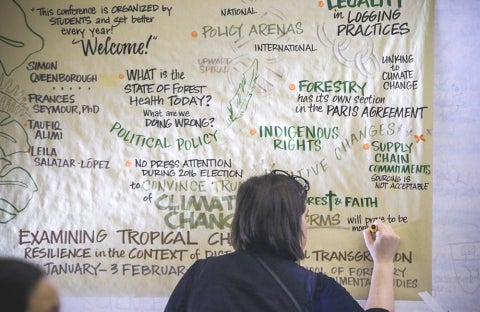 Calligrapher Heather Leavitt Martinez at work.
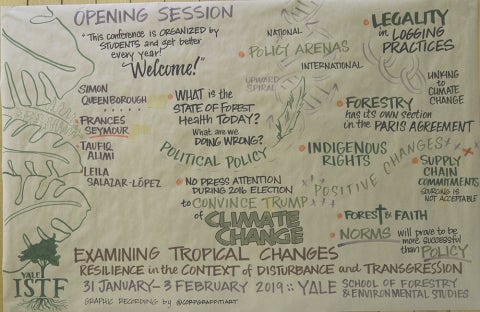 During the opening section, illustrated here by Calligrapher Heather Leavitt Martinez, Simon Queenborough, a lecturer and research scientist at F&ES and Musser Director of the Tropical Resources Institute, as well as visiting experts Taufiq Alimi, Leila Salazar-López, and Frances Seymour laid the framework of contemporary issues in tropical forestry from the most local — community sovereignty, economic incentives, and indigenous rights — to national and international policy concerns.
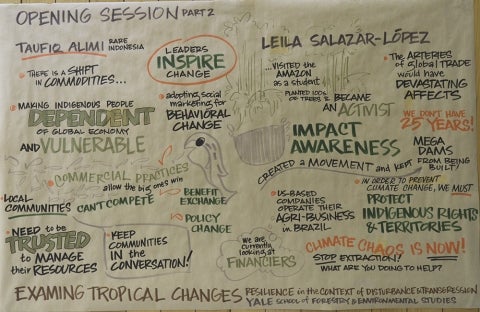 A second illustration captures the opening discussion.
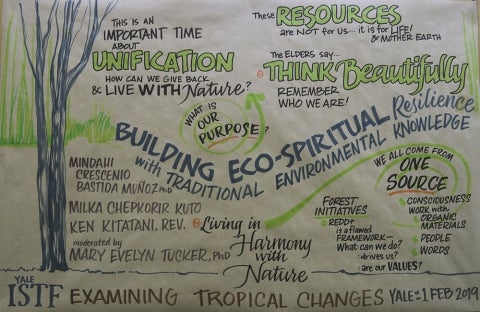 A panel featuring community leaders Milka Chepkorir Kuto, Rev. Ken Kitatani, and Mindahi Bastida Muñoz — as well as Mary Evelyn Tucker, senior lecturer and senior research scholar at F&ES — explored indigeneity and the close relationships between traditional communities and the Earth.
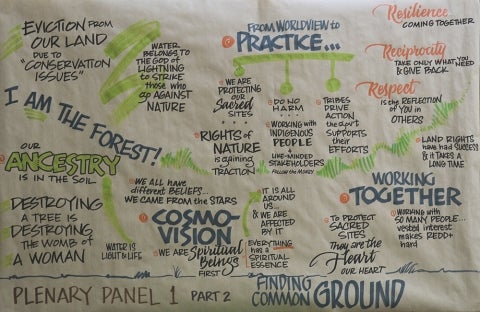 During the discussion on finding common ground, experts agreed on the importance of protecting the land rights of indigenous communities.<br />
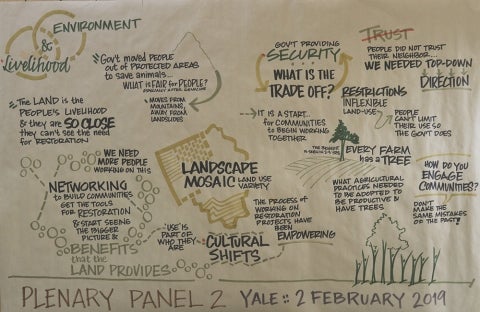 Restoration and conservation professionals Benjamin Brown, Paola Isaacs Cubides, and Michel Masozera explored challenges of restoration of degraded landscapes with Amy Vedder, a lecturer at F&ES who worked as a practitioner of international wildlife and wild lands conservation for 35 years before coming to Yale. Their discussion focused on community involvement in landscape restoration – rather than simply management by outside experts — and some of the challenges involved in community empowerment vs regulation.
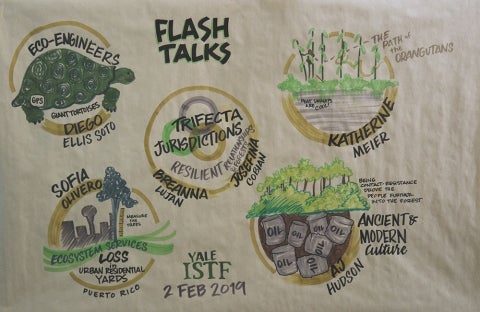 In a series of flash talks, graduate students and visiting practitioners shared brief case studies in tropical forestry.
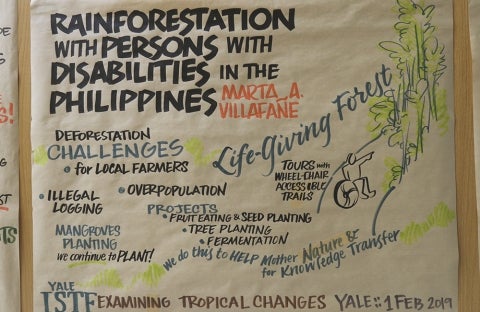 Marta Villafañe, founder of a reforestation-focused organization focused on the disabled and a recipient of ISTF’s 2019 Leadership Award, spoke about her dedication to continuing to plant mangroves despite challenges of illegal logging and deforestation and creating trails and activities accessible to people using wheelchairs. “We do this to help Mother Nature and to pass on this knowledge,” she said.
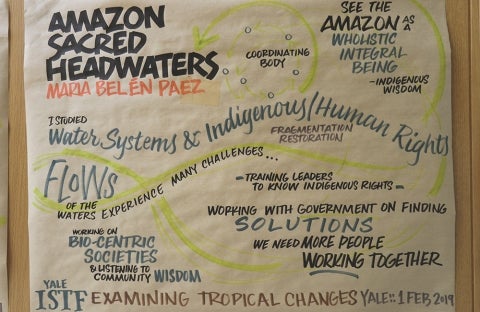 María Belén Pañez, founder of Fundacion Pachamama in Ecuador and also a 2019 Leadership Award Recipient, spoke about indigenous leadership in the Amazon and the need for collaborative work between government and communities. “We see the Amazon as a holistic integral being,” she said.
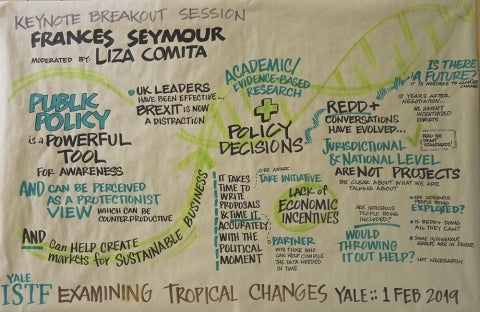 Frances Seymour, senior fellow at the World Resources Institute, and F&ES Prof. Liza Comita discussed the opportunities and challenges of public policy as a tool for promoting good land management. While public policy “is a powerful tool,” Seymour said, it can have drawbacks as well, citing the limitations of REDD+.
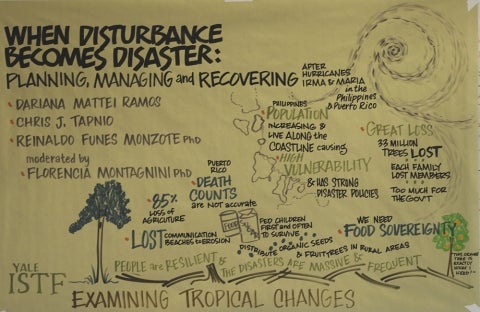 A panel with Dariana Mattei Ramos, Chris J Tapino, Reinaldo Funes Monzote, and Florencia Montagnini, a senior research scientist at F&ES (and director of the Program in Tropical Forestry and Agroforestry and Global Institute of Sustainable Forestry), compared the experience of the Philippines, Cuba, and Puerto Rico in recent natural disasters. The speakers shared experiences related to both ecology and governance and the challenges faced in their nations of becoming fully resilient to extreme weather events.
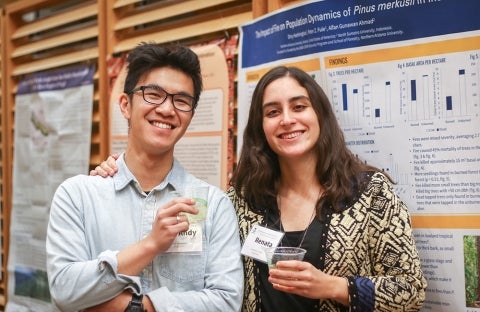 Andy Lee ’19 M.E.Sc. and Renata Lozano ’19 M.E.M., two members of the ISTF leadership team.
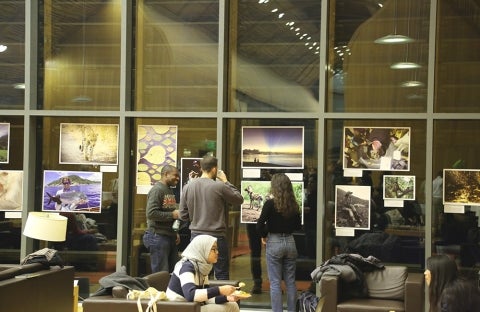 Students appreciated the ISTF Photography Competition during Friday evening’s social hour.
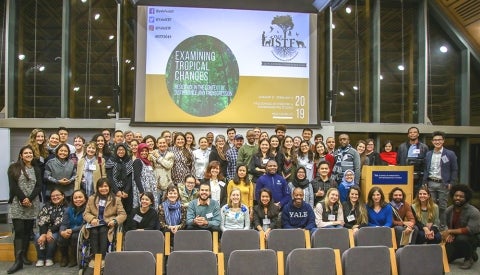 ISTF chapter members, speakers and conference attendees in Kroon Hall, home of the Yale School of Forestry & Environmental Studies.